Clothing for Women So He Can Fondle and Finger You in the Air on the Plane
Larn about your rights when encountering law enforcement at the aerodrome.
What types of law enforcement officers could I encounter when entering or leaving the United States?
If I am entering the U.Due south. with valid travel papers, tin can police enforcement officers stop and search me?
Generally, customs officers may stop people at the border to determine whether they are admissible to the United States, and they may search people'southward belongings for contraband. This is true fifty-fifty if in that location is nothing suspicious about you or your luggage. The authorities believes this authority to search without individualized suspicion extends to searches of electronic devices such as laptops and jail cell phones, simply that is a contested legal result. Officers may not select yous for a personal search or secondary inspection based on your religion, race, national origin, gender, ethnicity, or political beliefs.
Tin can edge officers enquire questions almost my immigration status?
Customs officers have the authority to ask your immigration status in lodge to determine whether you have the right to enter the country. If you are a U.Due south. citizen, yous need only respond questions establishing your identity and citizenship, although refusing to answer routine questions about the nature and purpose of your travel could issue in delay and/or further inspection. If you are a lawful permanent resident (LPR) who has maintained your status, y'all just take to answer questions establishing your identity and permanent residency. Refusal to answer other questions will likely crusade delay, simply officials may not deny y'all entry into the Us for failure to answer other questions. If yous are a non-citizen visa holder or visitor, you may be denied entry into the United States if you reject to answer officers' questions. Officers may not select yous for questioning based on your religion, race, national origin, gender, ethnicity, or political behavior. If you lot are told you cannot enter the country and you fright you might be persecuted or tortured if y'all are sent back to the land from which you traveled, yous should tell the customs officeholder about your fear and ask for aviary.
Can U.S. community officers ask questions nigh my religious beliefs and practices or political opinions?
Religious and political beliefs and associations are protected by the Get-go Subpoena. Customs officers accept sometimes asked travelers about their religious amalgamation, religious practices, association with religious institutions, and political opinions. The travelers targeted for such questioning have often been Muslim. Questioning individuals about their religious and political behavior, associations, and practices can infringe upon rights guaranteed by the Constitution and federal law — these rights are not surrendered at the border. If you are a U.S. citizen or lawful permanent resident, you practise not have to answer questions about your religious beliefs and practices or political opinions, and you cannot be denied entry to the United States for declining to answer such questions. If customs officers persist in asking you such questions, you can request to see a supervisor. If you are a non-denizen visa holder or visitor, you may refuse to answer general questions about your religious beliefs and political opinions, but doing so may lead to delay or additional questioning, or possibly denial of your entry into the country. If you are told you cannot enter the country and yous fear you might be persecuted or tortured if you are sent back to the land from which y'all traveled, you should tell the customs officer most your fear and ask for aviary.
Do I have to provide my fingerprints when inbound the country?
If I am selected for a longer interview when I am coming into the United States, what can I do?
Your legal status in the land may inform what yous decide to exercise if you are selected for longer questioning when entering the Usa. U.S. citizens have the right to enter the United states, so if you are a U.S. citizen and the officers' questions get intrusive, you tin turn down to reply those questions, but you should be enlightened that doing so may result in delay and/or further inspection. The same is truthful for lawful permanent residents: you by and large cannot exist denied entry to the United States, merely failing to answer questions may result in delay or further inspection. Refusal by not-citizen visa holders and visitors to answer questions may result in denial of entry.
If the officers' questions become intrusive or improper, yous should complain and inquire to speak to a supervisor. (This goes for citizens, lawful permanent residents, or non-citizen visa holders and visitors.) Although CBP takes the position that you are not entitled to an attorney during principal and secondary inspection, we encourage you lot to have the telephone number of an attorney or legal services organization with you and enquire to contact them if yous feel your rights are beingness violated or if you have been detained for an unusually long period. For anyone attempting to enter the U.s.a., if a community officer or border agent informs you that yous are nether arrest, or if it becomes clear that he or she suspects yous have committed a crime, you should ask to speak to a lawyer earlier answering any farther questions — and if you lot wish to exercise your correct to remain silent, you lot should say and then out loud.
Practise I accept to provide my laptop passwords or unlock my mobile phone for law enforcement officers at the border?
Community officers have sometimes asked travelers to provide their laptop passwords or unlock their mobile phones when they are entering or leaving the United States. Your legal status in the country may inform what yous decide to do if you lot're asked for a countersign to unlock your device. U.S. citizens cannot be denied entry to the U.s. for refusing to provide passwords or unlocking devices. Refusal to practice so might atomic number 82 to delay, additional questioning, and/or officers seizing your device for further inspection. The same should exist true for those who have previously been admitted to the U.Due south. equally lawful permanent residents and take maintained their status — their light-green cards can't be revoked without a hearing before an clearing judge. Visa holders and tourists from visa waiver countries, withal, run the risk of existence denied entry if they refuse to provide a countersign, and they should consider that risk before deciding how to continue. If an officer searches and/or confiscates your laptop or jail cell phone, get a receipt for your belongings.
For more than advice on electronic device searches at the edge, click here: https://www.aclu.org/blog/free-future/can-border-agents-search-your-electronic-devices-its-complicated
What if I am selected for a strip search at the border?
What types of constabulary enforcement officers and other regime officials could I encounter during the security screening procedure at the airdrome?
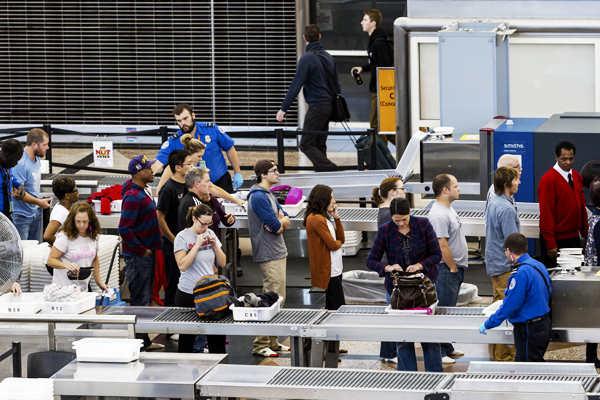
At airports, Transportation Security Administration (TSA) officers conduct security screenings. Most TSA officers are not commissioned law enforcement officers, and their role is to conduct screening of passengers, baggage and cargo. TSA screeners can search y'all and your baggage at screening checkpoints, but they cannot arrest yous. Other law enforcement officers, such as aerodrome law, are nowadays at airports.
What if I wear a religious head covering and I am selected by airdrome security officials for additional screening?
You lot have the right to wear your religious head covering. Yous should assert your right to clothing your religious head covering if asked to remove it before going through airport security screening. If an alarm goes off, however, airport security officers may request additional screening. They may and so comport a pat-down of your religious head covering or ask yous to remove it. You take the right to asking that the pat-down or removal be conducted by a person of your gender and that it occurs in a private area.
If you practise not want the TSA officeholder to touch your religious head covering, you must reject and say that you would prefer to pat down your own religious caput roofing. You lot volition and then be taken aside, and a TSA officer will supervise you as you lot pat downward your religious head covering. Subsequently the pat-downwards, the TSA officeholder may rub your hands with a small cotton fiber cloth and place it in a machine to test for chemical residual. If you laissez passer this chemical residue test, yous should exist allowed to go along to your flight. If the TSA officer insists on the removal of your religious head covering, you have a right to ask that it be washed in a private surface area. Officers may non conduct additional screening based solely on your race, national origin, faith, gender, ethnicity, or political beliefs.
What if I am traveling with children?
You may opt your children out of an airport browse. However, in that location is no exemption for children from the pat-down search. Children under thirteen years old may exit their shoes, lite jackets, and headwear on during screening.
What if I am traveling with breast milk or formula?
Parents and caregivers flying with and without children are permitted to bring breast milk and formula (and ice packs or other accessories required to absurd the breast milk or formula) in quantities greater than three ounces, equally long every bit you notify the officers about the items at the security checkpoint. When conveying breast milk or formula through the checkpoint, they will exist inspected. TSA officials may test the liquids for explosives. TSA officials may ask you to open the containers during the screening process. Breast milk and formula, along with other liquids and gels, may also be packed in your luggage and checked with your airline.
If I am on an airplane, can an airline employee interrogate me or inquire me to get off the plane?
An airline pilot may refuse to fly a passenger if south/he reasonably believes, based on ascertainment, that the rider is a threat to flight safety. A airplane pilot may non, however, question you lot or turn down to allow you on a flight because of biased stereotypes, including any based on your religion, race, national origin, gender, ethnicity, or political beliefs.
What do I do if I am questioned by law enforcement officers every time I travel past air and I believe I am on a "no-fly" or other "national security" listing?
If you believe you are mistakenly on a list, y'all should contact the TSA and file an research using the Traveler Redress Research Programme. More information is available hither. If y'all think there may exist some reason for why you have been placed on a list, yous should seek the advice of an attorney.
Source: https://www.aclu.org/know-your-rights/what-do-when-encountering-law-enforcement-airports-and-other-ports-entry-us/
0 Response to "Clothing for Women So He Can Fondle and Finger You in the Air on the Plane"
Post a Comment