The Earth Will Heat Then Will It Cool Again
Global warming doesn't stop on a dime. If people everywhere stopped called-for fossil fuels tomorrow, stored heat would yet keep to warm the atmosphere.
Moving-picture show how a radiator heats a habitation. Water is heated past a boiler, and the hot water circulates through pipes and radiators in the house. The radiators warm up and rut the air in the room. Fifty-fifty after the banality is turned off, the already heated water is still circulating through the organisation, heating the firm. The radiators are, in fact, cooling down, but their stored rut is still warming the air in the room.
This is known equally committed warming. Earth similarly has means of storing and releasing rut.
Emerging research is refining scientists' agreement of how Earth'southward committed warming will affect the climate. Where nosotros once thought it would take twoscore years or longer for global surface air temperature to peak once humans stopped heating upwards the planet, research now suggests temperature could peak in closer to x years.
But that doesn't mean the planet returns to its preindustrial climate or that nosotros avert disruptive effects such as sea level rising.
I am a professor of climate scientific discipline, and my research and teaching focus on the usability of climate knowledge by practitioners such equally urban planners, public health professionals and policymakers. With a new report on mitigating climate change expected from the Intergovernmental Console on Climate Change in early April, permit's take a await at the bigger film.
How agreement of peak warming has changed
Historically, the first climate models represented just the atmosphere and were profoundly simplified. Over the years, scientists added oceans, land, water ice sheets, chemistry and biological science.
Today's models can more explicitly represent the beliefs of greenhouse gases, especially carbon dioxide. That allows scientists to better carve up heating due to carbon dioxide in the temper from the office of heat stored in the sea.
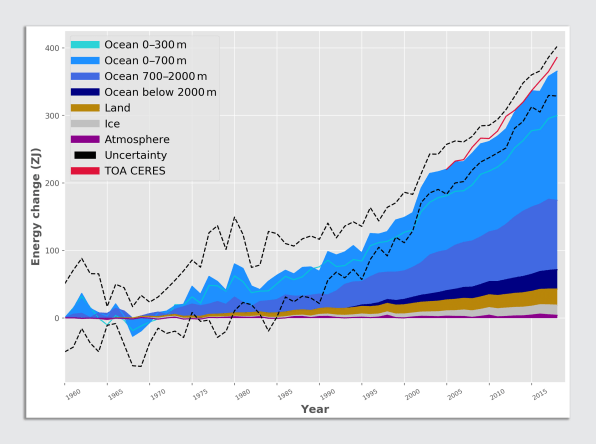
Thinking about our radiator illustration, increasing concentrations of greenhouse gases in World's atmosphere continue the boiler on—holding energy almost the surface and raising the temperature. Oestrus accumulates and is stored, mostly in the oceans, which take on the role of the radiators. The heat is distributed around the world through conditions and oceanic currents.
The current understanding is that if all of the additional heating to the planet caused past humans was eliminated, a plausible outcome is that Earth would accomplish a global surface air temperature peak in closer to x years than xl. The previous estimate of 40 or more years has been widely used over the years, including by me.
It is important to note that this is just the tiptop, when the temperature starts to stabilize—not the onset of rapid cooling or a reversal of climate change.
I believe there is plenty uncertainty to justify caution about exaggerating the significance of the new inquiry'south results. The authors applied the concept of pinnacle warming to global surface air temperature. Global surface air temperature is, metaphorically, the temperature in the "room," and is not the best measure of climate change. The concept of instantly cutting off homo-acquired heating is besides idealized and entirely unrealistic—doing that would involve much more than just catastrophe fossil fuel utilize, including widespread changes to agriculture—and it only helps illustrate how parts of the climate might carry.
Even if the air temperature were to peak and stabilize, "committed ice melting," "committed ocean level rise" and numerous other land and biological trends would keep to evolve from the accumulated heat. Some of these could, in fact, cause a release of carbon dioxide and methyl hydride, especially from the Arctic and other high-latitude reservoirs that are currently frozen.
For these reasons and others, it is of import to consider the how far into the future studies similar this one look.
Oceans in the future
Oceans will continue to store oestrus and exchange it with the atmosphere. Fifty-fifty if emissions stopped, the excess heat that has been accumulating in the ocean since preindustrial times would influence the climate for another 100 years or more.
Considering the ocean is dynamic, it has currents, and it will not simply diffuse its excess heat back into the atmosphere. There will be ups and downs as the temperature adjusts.
The oceans likewise influence the amount of carbon dioxide in the atmosphere, because carbon dioxide is both captivated and emitted by the oceans. Paleoclimate studies show large changes in carbon dioxide and temperature in the past, with the oceans playing an of import role.
Countries aren't shut to ending fossil fuel utilize
The possibility that a policy intervention might accept measurable impacts in ten years rather than several decades could motivate more aggressive efforts to remove carbon dioxide from the atmosphere. Information technology would be very satisfying to encounter policy interventions having nowadays rather than notional future benefits.
However, today, countries aren't anywhere close to ending their fossil fuel utilize. Instead, all of the evidence points to humanity experiencing rapid global warming in the coming decades.
Our near robust finding is that the less carbon dioxide humans release, the better off humanity will be. Committed warming and human behavior point to a need to accelerate efforts both to reduce greenhouse gas emissions and to adjust to this warming planet now, rather than simply talking nigh how much needs to happen in the future.
Richard B. (Ricky) Rood, Professor of Climate and Infinite Sciences and Engineering, University of Michigan
This article is republished from The Conversation under a Artistic Commons license. Read the original commodity.

Source: https://www.fastcompany.com/90737057/how-fast-can-we-stop-the-earth-from-warming
0 Response to "The Earth Will Heat Then Will It Cool Again"
Post a Comment