When Will Halleys Comet Come Again
Halley's Comet: Facts almost history'due south most famous comet
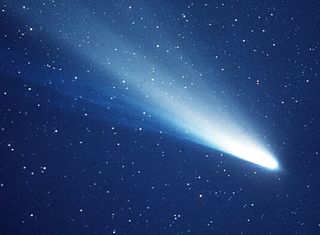
Halley'south Comet is arguably the nearly famous comet in history.
As a "periodic" comet, it returns to Earth's vicinity about every 75 years, making information technology possible for a person to see it twice in their lifetime. It was last hither in 1986, and it is projected to return in 2061.
The comet, officially chosen 1P/Halley, is named after English astronomer Edmond Halley, who examined reports of a comet budgeted Earth in 1531, 1607 and 1682. He concluded that these three comets were actually the same comet returning over and over again, and predicted that it would return in 1758. Halley'south calculations showed that at to the lowest degree some comets orbit the sunday.
Halley didn't live to run across the comet's correctly-predicted return, simply the comet was given his proper noun. (For those looking for help with pronunciation, the name traditionally rhymes with the give-and-take valley.)
Photos: Halley'south Comet Through History
Scientists finally got an upwards-close await at the comet when it last visited in 1986 when several spacecraft were sent to Halley'south vicinity to sample its composition. High-powered telescopes also observed the comet as it swung by Globe.
While the comet won't exist back for upward-close study for decades, scientists continue to investigate comets, looking at other small bodies. A notable instance was the Rosetta probe, which looked at Comet 67P/Churyumov–Gerasimenko betwixt 2014 and 2016 and concluded that the comet has a dissimilar kind of h2o than Globe's water.
The history of Halley'south comet
The first known observation of Halley's Comet, or Comet Halley, took identify in 239 B.C., co-ordinate to the European Space Agency. Chinese astronomers recorded its passage in the Shih Chi and Wen Hsien Thung Khao chronicles. Some other study (based on models of Halley's orbit) pushes that first observation back to 466 B.C., which would take fabricated it visible by the Ancient Greeks.
When Halley's returned in 164 B.C. and once more in 87 B.C., it probably was noted in Babylonian records now housed at the British Museum in London.
"These texts take of import bearing on the orbital motion of the comet in the ancient past," a enquiry newspaper in the journal Nature noted about the tablets.
Information technology's also thought that another appearance of the comet in 1301 could have inspired Italian painter Giotto's rendering of the Star of Bethlehem in "The Admiration of the Magi," according to the Britannica encyclopedia.
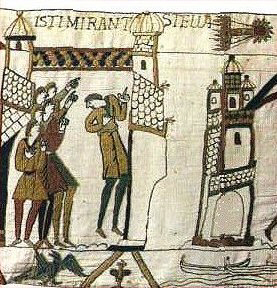
Halley's most famous advent occurred shortly earlier the 1066 invasion of England past William the Conqueror. Information technology is said that William believed the comet heralded his success. In any instance, the comet was put on the Bayeux Tapestry — which chronicles the invasion — in William'southward accolade.
Astronomers in these times, however, saw each appearance of Halley'southward Comet as an isolated consequence. Comets were often foreseen as a sign of great disaster or change.
Even when Shakespeare wrote his play "Julius Caesar" around 1600, merely 105 years before Edmond Halley calculated that the comet returns over and over once again, he included a now-famous phrase sepaking of comets equally heralds: "When beggars die there are no comets seen; The heavens themselves blaze along the expiry of princes."
Discovering Halley'due south comet
Astronomy began irresolute swiftly effectually Shakespeare's fourth dimension, however. Many astronomers of his fourth dimension believed that Earth was the center of the solar system, simply Nicolaus Copernicus — who died about 20 years earlier Shakespeare'due south nativity — published findings showing that the center was actually the sun.
It took several generations for Copernicus' calculations to take hold in the astronomy community, but when they did, they provided a powerful model for how objects move effectually the solar system and the universe.
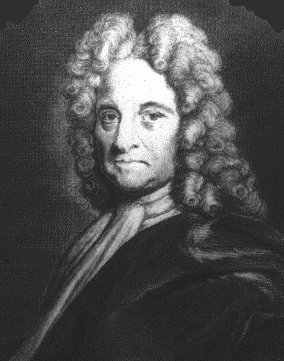
Years passed and the comet appeared in 1531, 1607 and 1682. Halley suggested the same comet could return to Earth in 1758. Halley did not alive long enough to see its return (he died in 1742) but his piece of work inspired others to proper noun the comet afterward him.
On each successive journey to the inner solar organization, astronomers on Earth turned their telescopes skyward to spotter Halley'south approach.
The comet'southward laissez passer in 1910 was especially spectacular, as the comet flew by nearly 13.nine million miles (22.4 meg kilometers) from Earth, which is almost ane-fifteenth the distance between Earth and the dominicus. On that occasion, Halley'southward Comet was captured on camera for the first fourth dimension.
According to biographer Albert Bigelow Paine, the writer Marker Twain said in 1909, "I came in with Halley's Comet in 1835. It is coming again next year, and I expect to leave with information technology." Twain died on April 21, 1910, one day after perihelion, when the comet emerged from the far side of the sun.
Halley-like comets
There is a group of comets called "Halley family comets" (HFC) because they appear to share the same orbital characteristics of Halley, including existence highly inclined to the orbits of Earth and other planets in the solar system. However, this family has a range of inclinations, which prompts other astronomers to suggest they may take a different origin than Halley.
Some suggest these comets could have evolved from members of the Oort Cloud, or from Centaurs (objects that generally accept a closest arroyo betwixt Jupiter and the Kuiper Belt.) Alternatively, HFCs could have come from somewhere just beyond Neptune.
Sending spacecraft to Halley's comet
When Halley's Comet came by Earth in 1986, it was the first time we could send spacecraft to look at information technology upwards close.
That was a fortunate occurrence, equally the comet ended up being underwhelming in observations from Globe. When the comet fabricated its closest arroyo to the sun, information technology was on the contrary side of that star from the Earth — making it a faint and distant object, some 39 million miles (63 million km) away from Earth.
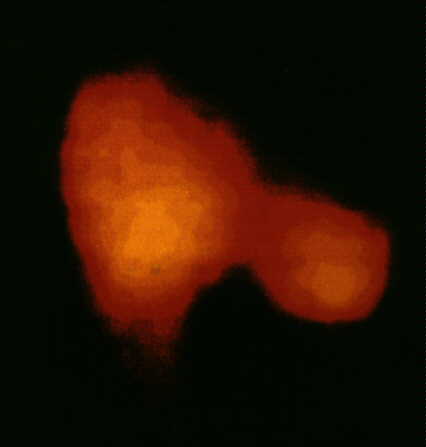
Several spacecraft successfully made the journeying to the comet. This fleet of spaceships is sometimes dubbed the "Halley Armada." Two joint Soviet/French probes (Vega i and 2) flew nearby, with one of them capturing pictures of the nucleus, or "eye," of the comet for the showtime time.
The European Space Bureau's Giotto craft got fifty-fifty closer to the nucleus, beaming back spectacular images to Earth. Nihon sent two probes of its ain (Sakigake and Suisei) that also obtained data on Halley.
NASA'south International Cometary Explorer (already in orbit since 1978) likewise captured pictures of Halley, snapping its shots from 17.3 meg miles (28 million km) away.
"It was inevitable that this nigh famous of all comets would receive unprecedented attention, simply the actual magnitude of the effort has surprised even nigh of those involved in information technology," NASA noted in an account of the result.
The astronauts aboard Challenger's STS-51L mission were also scheduled to look at the comet. But, sadly, they never got the chance. The shuttle exploded about 2 minutes after launch on Jan. 28, 1986, due to a rocket malfunction, killing all 7 astronauts on board.
It will be decades until Halley's gets close to Globe again in 2061, but in the meantime, you tin can see its remnants every year. The Orionid meteor shower, which is spawned by Halley'southward fragments, occurs annually in October. Halley'due south likewise producedsa shower in May, called the Eta Aquarids.
When Halley's sweeps past Globe in 2061, the comet will exist on the same side of the lord's day as Earth and will be much brighter than in 1986. At least 1 study has pointed out that information technology is difficult to predict Halley's orbit on a scale of more 100 years, and that the comet could collide with some other object (or be ejected from the solar arrangement) in as little every bit 10,000 years, although non all scientists concur with the hypothesis.
When Halley adjacent returns to Earth's vicinity, one astronomer predicted it could be as brilliant as apparent magnitude -0.3. This is relatively bright, simply it won't be the brightest object to skywatchers equally it volition be well below that of the brightest star in Globe's sky: Sirius, at magnitude -1.four as seen from Earth.
While information technology volition exist decades before we can send another spacecraft to Halley'south Comet, there take several other missions that take studied comets from up close. Between 2014 and 2016, for case, the Rosetta probe examined Comet 67P/Churyumov–Gerasimenko up close and made comparisons to other comets.
I of its key findings was uncovering that Comet 67P had a unlike kind of h2o (specifically, a different deuterium-to-hydrogen ratio) than what is seen on Globe. Back in the 1980s, similar examinations of Halley by the Giotto probe also showed that Halley has a different D-to-H ratio in its water than on Earth.
Other notable cometary missions include NASA's Stardust (which captured samples of comet 81P/Wild and returned them to Earth), NASA's Deep Impact (which deliberately sent an impactor into 9P/Tempel on July iv, 2005), and the European Space Agency'due south Philae (which landed on Comet 67P in 2014.)
This reference page was updated on January. 11, 2022 by Infinite.com senior writer Chelsea Gohd.
Boosted resources
- How to photograph Comet NEOWISE: NASA tips for stargazers
- Comet Leonard will light up the sky this month — here's how to see it
- Astonishing photos of Comet NEOWISE from the Earth and space
Bring together our Space Forums to keep talking space on the latest missions, dark sky and more than! And if you have a news tip, correction or annotate, permit us know at: customs@space.com.

Elizabeth Howell, Ph.D., is a contributing writer for Infinite.com since 2012. As a proud Trekkie and Canadian, she tackles topics similar spaceflight, diversity, science fiction, astronomy and gaming to help others explore the universe. Elizabeth's on-site reporting includes 2 human spaceflight launches from Republic of kazakhstan, and embedded reporting from a imitation Mars mission in Utah. She holds a Ph.D. and G.Sc. in Space Studies from the University of North Dakota, and a Bachelor of Journalism from Canada's Carleton University. Her latest volume, NASA Leadership Moments, is co-written with astronaut Dave Williams. Elizabeth first got interested in space subsequently watching the motion picture Apollo thirteen in 1996, and yet wants to be an astronaut someday.
Source: https://www.space.com/19878-halleys-comet.html
0 Response to "When Will Halleys Comet Come Again"
Post a Comment